
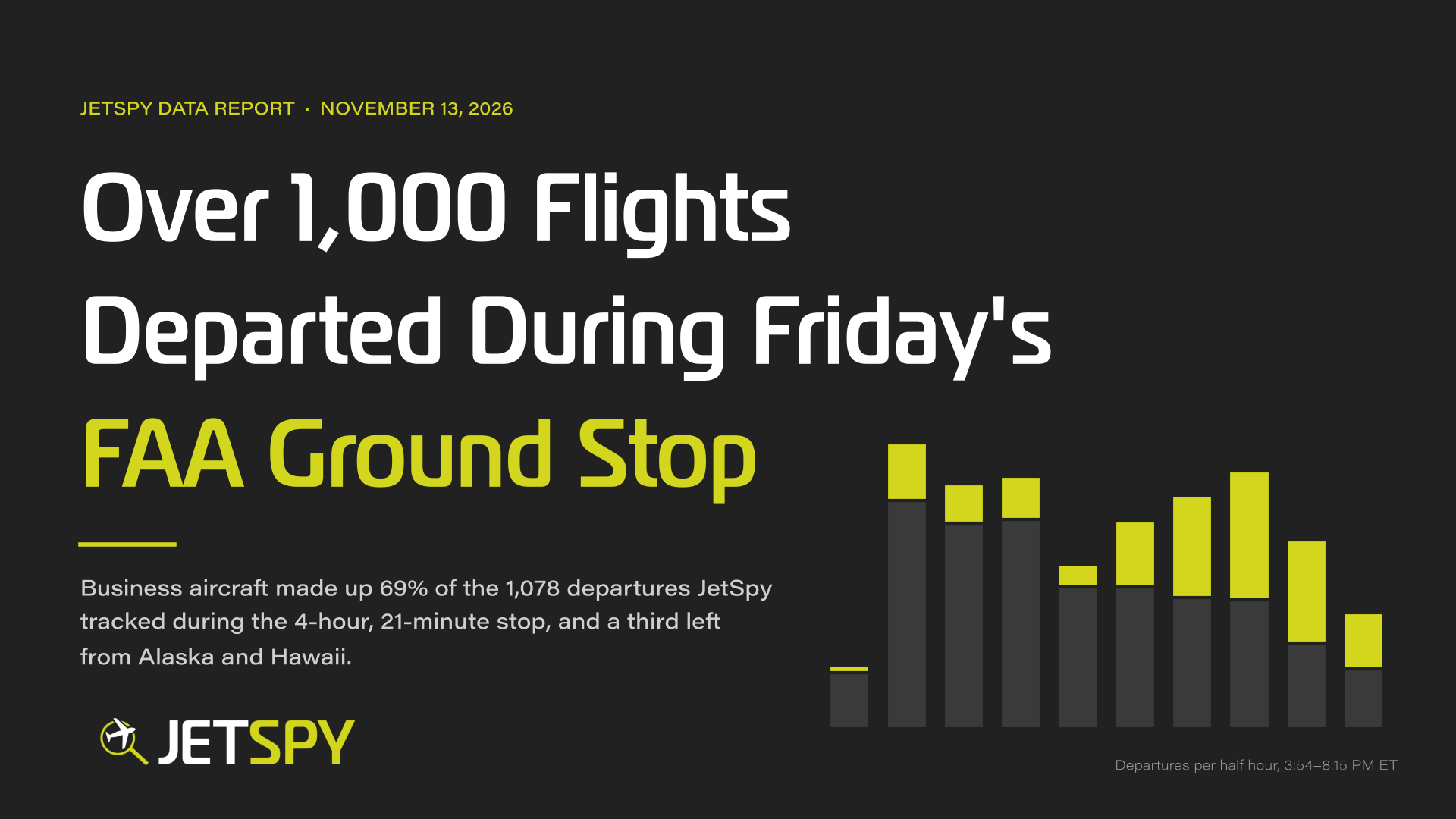
JetSpy recorded 1,078 departures from U.S. airports while the FAA’s nationwide ground stop was in effect on Friday, November 13, from 3:54 to 8:15 PM ET. Business aircraft made up 743 of these departures (69%), while commercial aircraft accounted for 335 (31%).
The stop followed communication problems at multiple Air Route Traffic Control Centers. It halted most departures across the country, but not all of them: a third of the flights that kept moving left from Alaska and Hawaii, and long-haul widebodies filled the final hours.
Why flights continued to take off
The ground stop was nationwide, but certain flights continued to depart for several reported reasons:
- Alaska and Hawaii: Alaska Airlines said flights within Alaska and Hawaii inter-island flights were not affected, West Coast–Hawaii flights could continue, and international flights from Honolulu were cleared.
- International departures: some flights leaving U.S. airspace were cleared, and United said the FAA was handling international departures case by case.
- Pacific-bound flights: SFO and Ontario said westbound flights over the ocean were cleared to depart.
- Local VFR flights: aviation outlets reported that VFR flights not relying on the affected en-route centers kept operating at many general aviation airports, though VFR alone didn’t exempt a flight from the order.
Business aircraft led early; commercial aircraft took over late
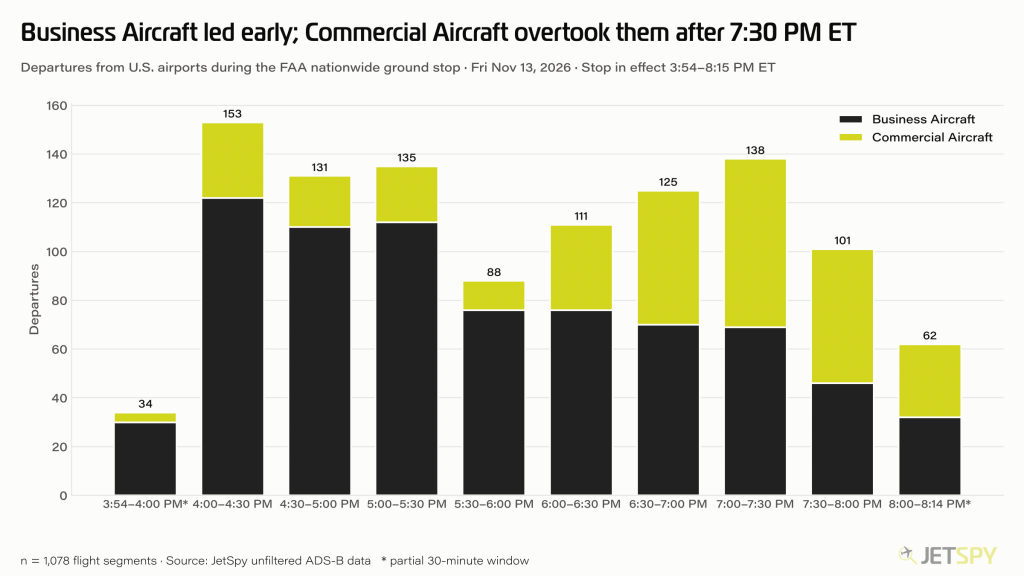
For the first three and a half hours, business aircraft accounted for most departures, peaking at 122 between 4:00 and 4:30 PM ET. Commercial departures climbed steadily after 6:00 PM ET, tied business aircraft at 69 each between 7:00 and 7:30 PM ET, and pulled ahead after 7:30 PM ET.
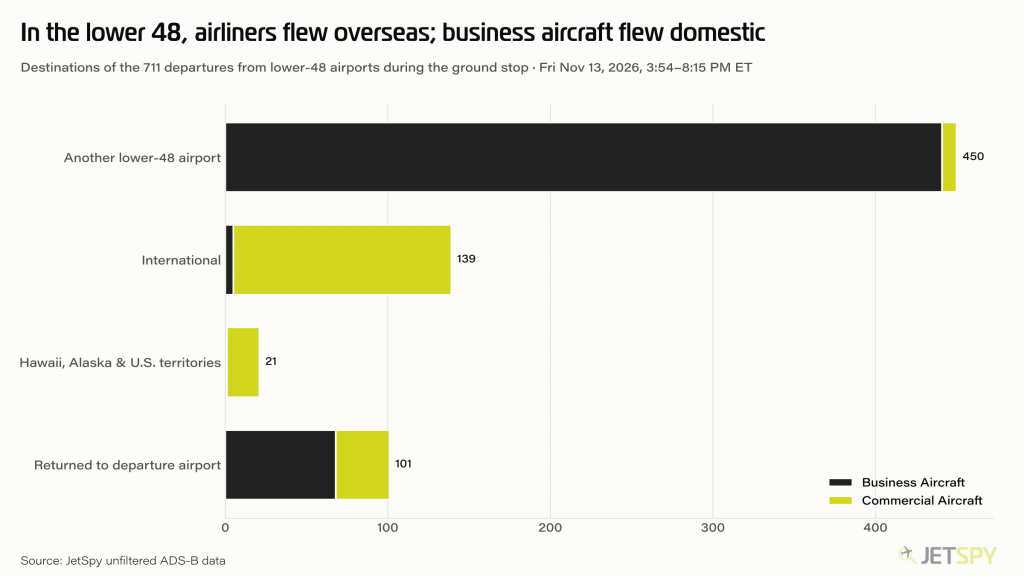
The late commercial wave was almost entirely long-haul flying. Of the 196 commercial departures from lower-48 airports, 134 were bound for another country and 17 for Hawaii. JFK, Dulles and Miami recorded no departures until 5:30 to 7:00 PM ET, matching reports that the FAA cleared international flights on a case by case basis.
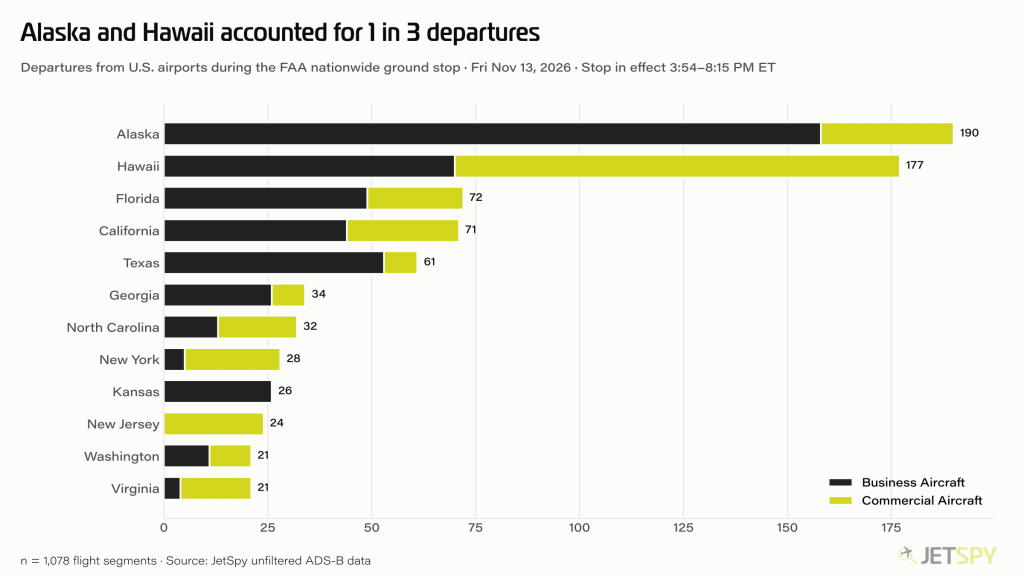
Alaska and Hawaii accounted for 1 in 3 departures
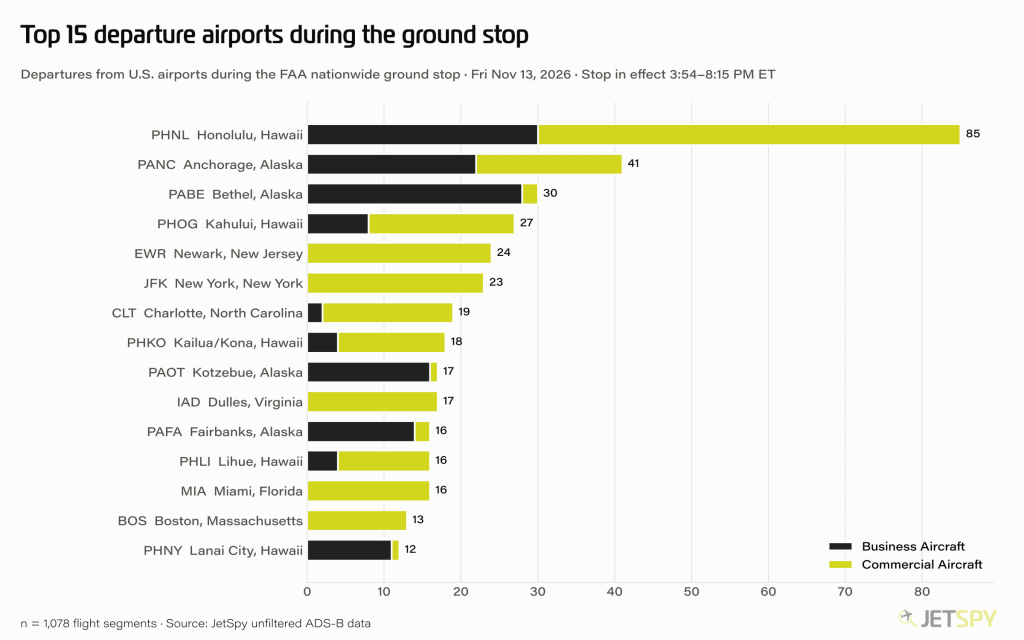
Alaska (190) and Hawaii (177) together produced 367 departures, 34% of the total. Honolulu was the busiest airport by far with 85, followed by Anchorage (41), Bethel (30) and Kahului (27).
In the lower 48, the busiest airports were international gateways served almost entirely by commercial aircraft: Newark (24), JFK (23), Charlotte (19), Dulles (17), Miami (16) and Boston (13). Sixteen of Charlotte’s 19 departures took off in the first 35 minutes of the stop and landed back at Charlotte, likely recalled once the stop took effect.
Business aircraft in the lower 48 were spread thin. Their 515 departures came from 339 airports, led by Texas, Florida and California, with no single airport above seven.
Turboprops carried the business aviation count
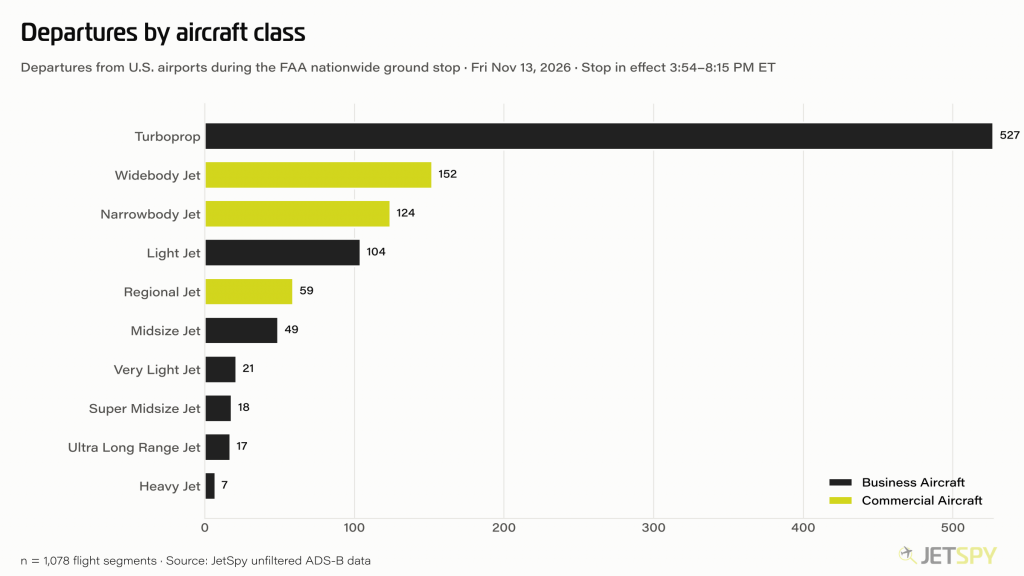
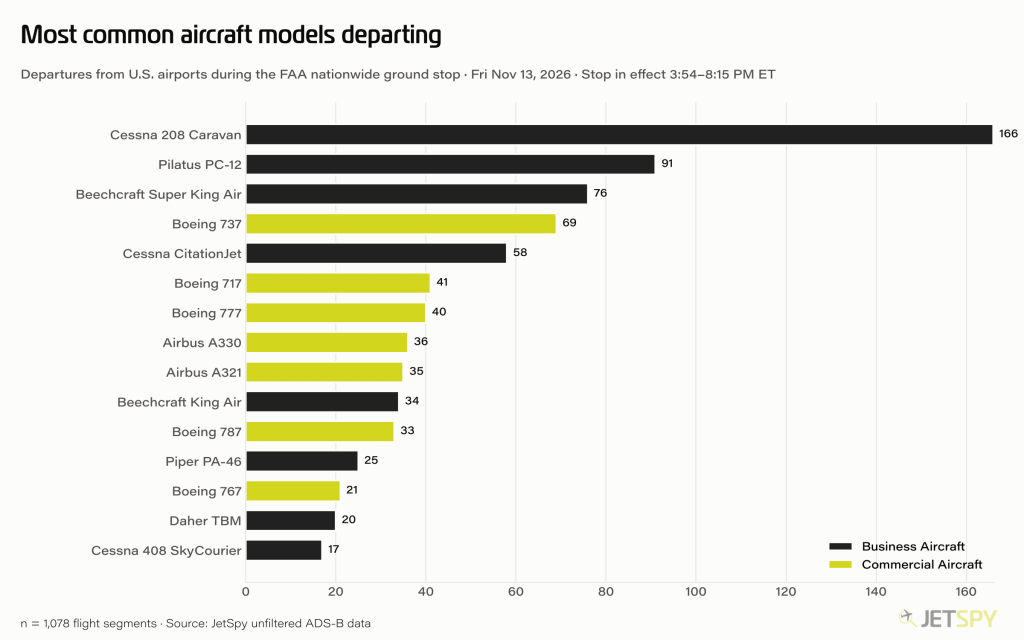
Turboprops made up 527 of the 743 business departures (71%). The Cessna 208 Caravan led every aircraft type with 166 departures, ahead of the Pilatus PC-12 (91) and Beechcraft Super King Air (76). Of those 527 turboprop departures, 222 came from Alaska and Hawaii.
Business jets accounted for 216 departures, led by light jets (104) and the Cessna CitationJet family (58). Seventeen ultra-long-range jets also departed, including Global 7500s, G500s and a G550.
On the commercial side, the Boeing 737 (69), Boeing 717 (41, all from Hawaii airports) and Boeing 777 (40) were the most common types. Widebodies alone made up 152 departures.
Airliners flew overseas; business aircraft flew domestic
Outside of Alaska and Hawaii, the two segments did different things. Business aircraft made 441 flights between lower-48 airports. Commercial aircraft made nine, and none were ordinary airline trips mid-stop: five left in the first 18 minutes, and four were military 737s, including three on the Las Vegas–Tonopah Test Range route.
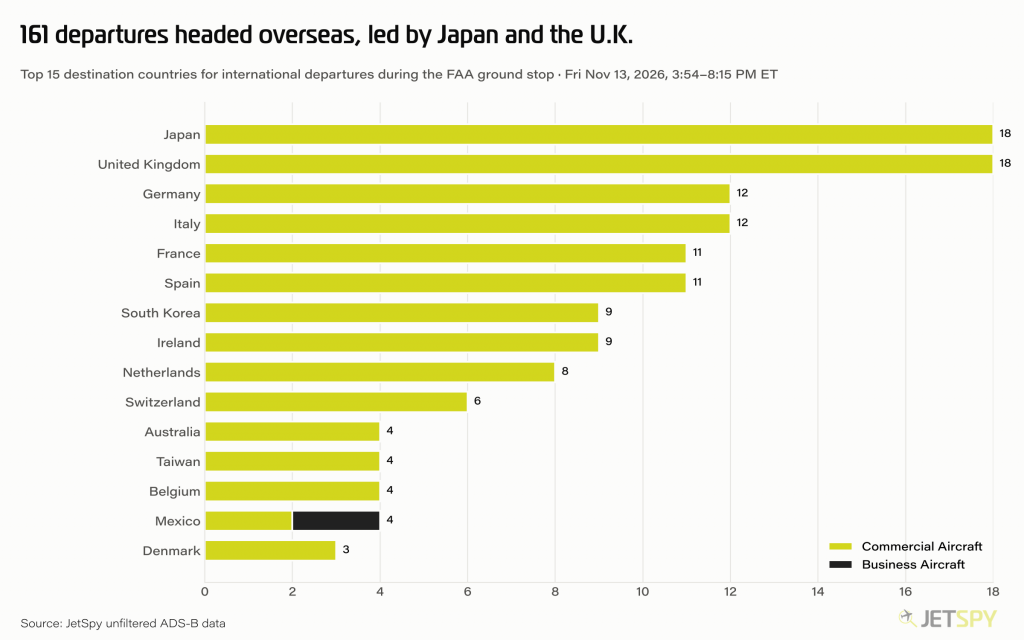
Two Alaska Airlines 737s left Portland and Seattle for Anchorage at 7:59 and 8:02 PM ET, minutes before the lift. In total, 161 departures headed overseas, led by Japan (18) and the United Kingdom (18, all to London Heathrow).
Medical flights were 1 in 7 lower-48 business departures
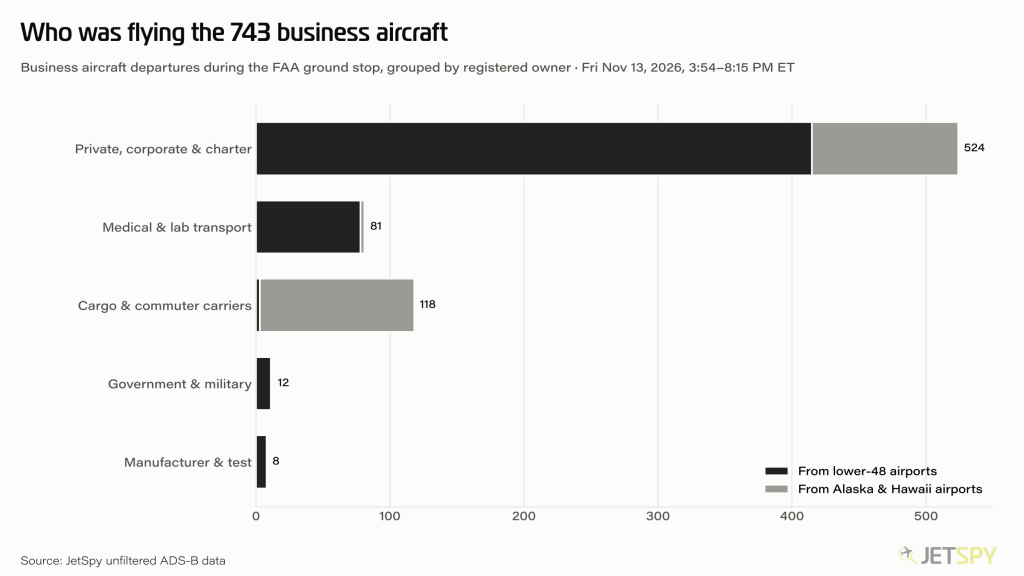
Registered owners show who kept the business fleet moving. In the lower 48, 78 of 515 business departures (15%) were registered to air ambulance, organ transport or lab specimen operators, led by Guardian Flight (13 across all airports), TransMedics (10) and Air Methods (7). Another 12 belonged to government and military owners, including the Air Force, Coast Guard, Civil Air Patrol and two state governments.
In Alaska and Hawaii, about half of the 228 business departures (115) were by cargo and commuter carriers such as Bering Air (30), FedEx (21), Ryan Air (15) and Southern Airways Pacific (15). Textron Aviation owned all six departures from its Wichita factory fields, which looped back to where they started.
Methodology
- Data: 1,078 flight segments from U.S. airports logged by JetSpy’s unfiltered ADS-B network originating between 3:54 and 8:15 PM ET on November 13, 2026, the window of the FAA ground stop. A segment begins only when an aircraft takes off.
- Classification: aircraft are grouped by type, not by operator or purpose. “Business Aircraft” includes business jets, and turboprops such as the Caravan, SkyCourier, Twin Otter and Beech 1900 that are also widely used for cargo and commuter service. “Commercial Aircraft” covers commercial jets (airliner types).
- Owner groups: business aircraft are grouped by keywords in the registered owner’s name (medical, government, named cargo and commuter carriers, manufacturers). The groups are approximate.
- Counts are flights, not aircraft: one aircraft flying several legs during the stop counts once per leg.
- Returns: 113 flights landed back at the airport they took off from. Of the 36 airliners among them, 24 took off in the first hour of the stop, consistent with aircraft recalled to land.
- Destinations: 133 segments have no landing airport on record; they are placed by their last known position.